muir↗CADR PRESERVED.
QUUX EVOLVED.

Project
Muir.

A project about MIT’s CADR Lisp Machine, with three aims.

  1. Simulate the CADR accurately: in software (muir-sim’s cadr) and in hardware (muir-fpga’s CADR), from MIT’s schematics and sources, running MIT’s system and muir-sys’s 1xxx releases for the CADR.

  2. Evolve it into QUUX, a modern design, again in software (muir-sim’s quux) and in hardware (muir-fpga’s QUUX), running the updated system (muir-sys’s 2xxx releases for QUUX).

  3. Build it with AI: the Rust, the SystemVerilog, the Lisp changes and the FPGA work are written by Claude, through Claude Code; MIT’s own sources stay MIT’s.

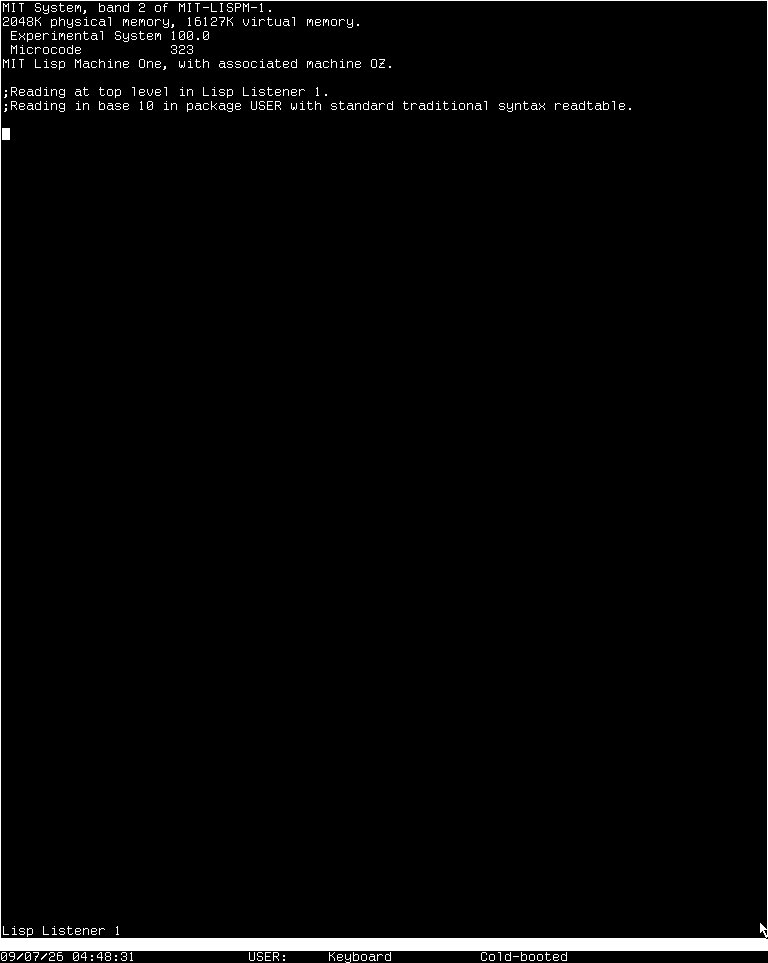
FIG. 01 — OUR STARTING POINTMIT / CADR
MIT · ARTIFICIAL INTELLIGENCE LABORATORY
MIT's System 100 at its Lisp Listener, running in muir-sim
CADR / MIT’S RELEASED SYSTEM.
The original machine, running in muir-sim.
An artistic impression, not the CADR itself.
↗

01 / THE TWO MACHINES

The original,
and QUUX, evolved from it.

Two purposes, on one base.
QUUX is where the changes are made.

THE MIT ORIGINALAROUND 1978

CADR↙

The original, down to its chips.

MIT’s machine as it was built. Its simulation follows the original board schematics and runs the historical microcode and Lisp software. QUUX starts from it.

  • MIT’s processor, buses and peripheral boards
  • MIT’s original microcode and released system
  • Three simulation engines, down to chip level
MIT’S MACHINE · THE ORIGINAL
Inside the CADR
THE CADR, EVOLVED2026

QUUX↗

The CADR’s design, taken further.

QUUX starts from the CADR and its way of running Lisp, and changes the processor, its memory and its devices wherever a change pays for itself.

  • A 40-bit word, a tag over a 32-bit field
  • Main memory on its own port, 28-bit physical and 32-bit virtual addresses
  • Paging in hardware, a page table behind a TLB
  • A four-stage pipeline
  • A generational garbage collector
  • Ethernet and TCP/IP in place of Chaosnet
MUIR’S MACHINE
What QUUX changes
FeatureCADRQUUX
The word32 bits40 bits
Execution145 ns microcycles, delay linesA four-stage pipeline
Main memoryMemory boards on the XbusThe memory bus, on the processor’s own port
Memory cacheNone4K to 64K words, by board
Address translationA two-level map, 31 regions mapped at onceA page table behind a TLB
PDL buffer1K words16K words
Multiply and divide32 steps eachOne instruction each
Clocks and interval timersMicrosecond clock and one interval timer on the I/O boardMicrosecond clock in the processor, three interval timers
Real-time clockNoneUnix seconds in one word
DisplayTV board, 768 by 963Video controller, up to 1920 by 1080
DiskDisk controller, by cylinder, head and sectorBlock-disk, by block number
Disk fileMIT’s pack and labelA raw image or a VHD, with a GPT
BusesXbus and Unibus, with a bus interface and an I/O boardNone: the register page
File accessOver the Chaosnet, from a file serverThe file device
NetworkChaosnetEthernet, with ARP, IPv4, ICMP and TCP
DebuggingConsole registers on the Unibus, and a debug cable between machinesThe host’s port alone
MicrocodeMIT’s 323muir-sys’s 2xxx
Lisp systemMIT’s System 100muir-sys’s Systems 2xxx
Garbage collectorMIT’s incremental copying collectorA generational collector
Everything QUUX changes, in full ↗

02 / ONE REPOSITORY EACH

The projects.

SIMULATORRUST

muir-sim

CADR and QUUX, simulated.

MIT’s CADR simulated from MIT’s own schematics of its boards, at three levels of detail down to every chip, booting MIT’s released system; and QUUX beside it. Two machines: cadr and quux.

The CADR finds its files on ozd.

The simulator
FPGASYSTEMVERILOG

muir-fpga

The machines in the fabric of FPGA boards.

muir-sim’s RTL model of the CADR and of QUUX in the fabric of small FPGA boards, held to muir-sim tick for tick.

A CADR board finds its files on ozd.

The boards
SYSTEMLISP

muir-sys

The Lisp Machine system.

The system that runs on both machines, continuing where MIT’s released system left off, with releases for both: the updated system for QUUX, and the CADR’s own.

The system

03 / MIT, AROUND 1978

The shared
origin.

A workstation for one person, written in Lisp.

The CADR, MIT’s Lisp Machine, became the foundation for the first Lisp Machines sold by LMI and Symbolics. LMI’s Lambda ran the CADR’s software, its microcode assembled from the same sources, and Texas Instruments’ Explorer was made from the Lambda’s design. muir-sim simulates the CADR, running MIT’s last release of its system, restored from recovered tapes; muir-fpga puts it in the fabric of an FPGA.

Inside the CADR

04 / LMI, 1979 TO 1986

The CADR, the Lambda
and the K-machine.

Lisp Machine, Inc. was founded in 1979 by Richard Greenblatt of MIT’s AI Lab, with Stephen Wyle, to build Lisp Machines on its customers’ money: they paid for their machines in advance.

LMI · MIT’S DESIGN32-BIT WORD

CADR

MIT’s machine, built as MIT built it.

LMI’s first machines were the CADR itself, the same logical and physical design as MIT’s; Greenblatt recalls about thirty-five of them.

LMI · 198232-BIT WORD

Lambda

The CADR’s successor, on the NuBus.

The Lambda, described in 1982, put its processor on four boards on the NuBus, a bus also from MIT, and ran the CADR’s software; its microcode was assembled from the CADR’s own sources. Two processors could share one box. Its word is 32 bits, as the CADR’s; a 40-bit version was planned.

LMI · 198664-BIT INSTRUCTION

K-machine

A new design, never sold.

Not descended from MIT’s machines: 32-bit objects, a 6-bit tag over a 26-bit pointer, 64-bit instructions and a four-stage pipeline. It ran its first instructions on 31 December 1986; LMI’s money ran out before it reached the market.

05 / SYMBOLICS, 1983 AND 1987

The 3600
and the Ivory.

Symbolics was founded by staff of MIT’s AI Lab to make Lisp Machines. Its first machine, the LM-2 (1981), was the CADR’s design repackaged.

SYMBOLICS · 198336-BIT WORD

3600

Symbolics’ own design.

The 3600 was a new design, inspired by the CADR but sharing few of its implementation details. Its word is 36 bits.

SYMBOLICS · 198740-BIT WORD

Ivory

The processor on one chip.

The Ivory, described in 1987, put the processor on a single chip. Its word is 40 bits: a 2-bit cdr code, a 6-bit type and a 32-bit field.

06 / ABOUT

MIT’s machine, and
what this project adds.

The CADR, its schematics, wire lists, microcode and system are MIT’s, recovered by other people’s work over decades; muir-sim’s manual lists every source and what each contributed. This project made muir-sim, the simulator of the CADR and its three engines; muir-fpga, which puts the CADR and QUUX in the fabric of FPGA boards; QUUX, the CADR evolved, and muir-sys’s updated system for it; and ozd, the CADR’s associated machine.

The projects are written with Claude Code, on Anthropic’s models; each project’s own page says how it was made. The site is written using OpenAI’s and Anthropic’s models.

Muir is named for Nathan Muir, the character Robert Redford plays in Spy Game (2001). In memory of Robert Redford.

© 2026 Mete Balci. Every project, and this site, is AGPL-3.0-or-later; the site’s fonts, IBM Plex Mono and Gelasio, are under the SIL Open Font License 1.1: IBM Plex Mono’s and Gelasio’s licence texts.